- Minimum order: 1 container (about 20 t)
- Ready to pack and ship
- Sample on request, where lawful
- Export documents supplied
| Grade | Variety | Nicotine | Sugar | E.V. | Available | Packing | Price / kg | Typical use | |
|---|---|---|---|---|---|---|---|---|---|
| MMO | FCV | 2.5% | 13–15% | 1 | 50 t | Jute bags | 8.10 | Highest sugar; sweet aroma. Common shisha and molasses base. | Order |
| MML | FCV | 2.5% | 9–11% | 2 | 50 t | Jute bags | 8.35 | Balanced sweetness and strength; cigarette, RYO and flavoured blends. | Order |
| NDB | FCV | 2.5% | 7% | 3 | 50 t | Jute bags | 8.20 | Drier, bolder leaf; mass-market cigarette and bidi base. | Order |
| TND | FCV | 2.5% | 8% | 4 | 50 t | Jute bags | 8.20 | Mid-strength, neutral base; blending and reconstitution. | Order |
| DAC | FCV, low nicotine | 1.3% | 3% | 3 | 180 t | Jute bags | 8.90 | Low-nicotine, low-sugar base for light blends. | Order |
| DV-MM-1 (Grade 1) | Dark air-cured | 1.1% | 3% | – | 50 units | Jute bags | 8.00 | Dark air-cured loose leaf; chewing, snuff, hand-rolled, cigar filler. | Order |
E.V. is the equilibrium value from our lot sheets, an indicator of moisture balance. Ask for the lot sheet if it matters to your process. All figures are for the 2026 crop and are confirmed per lot.
Choosing loose leaf
When loose leaf is the right form
Loose leaf keeps the original leaf structure, which gives you control over sorting, stemming, conditioning, cutting and blending. It suits plants that already have stemming equipment and the labour to run it. The trade-off is simple: you do more of the work, and you pay for stem you will later remove.
If you would rather buy leaf that is already stemmed, see hand-stemmed, machine-stemmed and the strips table.
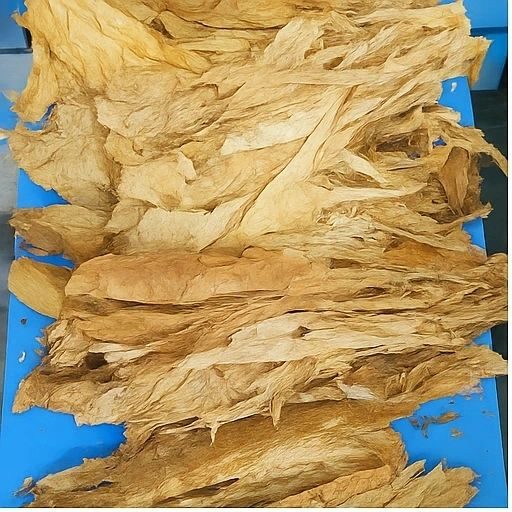
Picking among the loose grades
- Sweet and aromatic: MMO and MML. For the high-sugar case see shisha base leaf.
- Drier and firmer: NDB and TND, for cigarette and bidi bases. Grade profiles are on the FCV page.
- Low nicotine and low sugar: DAC and DV-MM-1. See dark air-cured.
Practical points
- Loose leaf is packed in jute bags, which let it breathe. Keep the bags dry and off the floor on arrival.
- Compare loose and stemmed offers on usable yield, not on price per kg alone.
- Ask for the lot sheet or test result for the lot, not a generic one.
Packing, samples, documents and payment: wholesale terms.
After delivery: handling, inspection and cost
What happens to loose leaf when it reaches your plant
Loose leaf arrives dry and relatively brittle. Before it can be stemmed or cut without breaking into fines, it has to be conditioned: brought up to a working moisture with humidified air or steam, so that it becomes pliable. After conditioning, the leaf is stemmed or threshed, the lamina is separated from the midrib, and the strips are re-dried to a safe storage moisture before cutting or blending. Each of those steps takes equipment, labour and time, which is why loose leaf is the form for plants that already have a processing line.
Receiving a delivery: a short inspection routine
- Check the container first. Look for water damage, taint, broken seals or signs of condensation. Record it before unloading.
- Count and weigh. Compare the number and weight of bags with the packing list.
- Draw samples from several bags, not just the ones at the door. A common rule of thumb is to sample from roughly the square root of the number of bags, plus one, spread across the load.
- Smell, bend and squeeze each sample, as in our sample checklist.
- Measure moisture and keep a sealed retained sample for any later dispute.
- Store properly. Off the floor, away from walls, cool and dry, with labels showing the lot.
If anything is wrong, photograph it, note it and contact us within the inspection period set in the contract.
Working out the real cost of loose leaf
Loose leaf includes the stem, so a kilogram of loose leaf is not a kilogram of usable lamina. The way to compare it with strips is to work out the cost per kilogram of usable material. As a purely hypothetical example: if a loose lot costs $8.00 per kilogram and about a quarter of its weight is stem you will discard, you are paying $8.00 for 0.75 kg of lamina, or about $10.67 per kilogram of usable leaf, before adding your own stemming labour, energy and equipment. Strips at a similar price per kilogram would be better value in that case; strips at a much higher price might not be. Use your own stem percentage and your own cost to run the same calculation. The numbers in the example are not our figures.
Who loose leaf suits
Who should buy loose leaf
- Manufacturers with their own conditioning, threshing and re-drying line.
- Producers that want full control of strip size and stem removal.
- Buyers that value the lowest price per kilogram and have the labour to process the leaf.
- Blenders who want to inspect whole-leaf quality before cutting.
Who should look at stemmed forms instead
- Plants without stemming equipment.
- Small factories that cannot justify the labour.
- Shisha and RYO makers who cut very fine and are sensitive to stem and fines (see shisha leaf).
- Anyone who needs to shorten the time from delivery to production.
The options are on the hand-stemmed, machine-stemmed and strips pages.
Reading the table, packing and decisions
Using the loose leaf table
Each row is a lot we hold or can offer. Read it from left to right: the grade code, then the tobacco type, then nicotine and sugar. Next come the equilibrium value, the quantity available, the packing and the indicative price. The last column is the typical use we expect for that grade, not a promise. The quantity is a guide to how much of the lot is available at the time of writing; ask for the current figure. The price is per kilogram, FOB Karachi, and your quotation fixes it.
If your recipe sits between two rows, tell us the nicotine and sugar you want and we will propose a mix of lots, as described on our blends page.
Packing and storage of jute bags
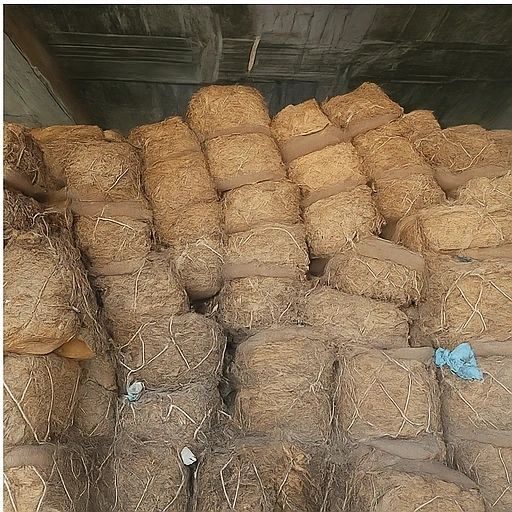
Loose leaf is packed in jute bags, which are breathable, easy to stack and widely used for tobacco. Their weakness is that they offer little protection against moisture from outside. On arrival, move the bags into a dry store and keep them off the ground. If you will hold stock for more than a few weeks, rotate it and check for beetle activity.
Working through the table: a decision walkthrough
Choosing between loose grades is easier if you go in a fixed order instead of scanning the whole table.
- Decide the character first. Do you want a sweet, aromatic leaf, a drier firmer one or a low-nicotine one? That narrows you to a few rows.
- Check the nicotine and sugar of those rows against your recipe, as a range, not a single number.
- Check the quantity. If you want a full container of one grade and the available quantity is smaller, you will need to mix lots or wait for the next crop.
- Look at the packing, to see whether jute bags suit your handling.
- Compare the price last. A small price gap matters less than fit.
- Ask for a sample of the two closest candidates and test them side by side.
Blending and the buying calendar
Using loose leaf in blending
Because loose leaf is unprocessed, blenders often use it in a layered blend, where leaf from several grades is laid down in thin layers and then cut across, so each cut contains a mix. The advantage is that the blend can be adjusted by changing the layers. The risk is uneven mixing if the layers are not matched to the cutting. If you are new to loose-leaf blending, start with two grades and test a small batch before expanding.
A buying calendar
Leaf is seasonal, and the best choice is usually available soon after the crop is graded. A manufacturer who needs consistent leaf throughout the year typically does one of two things: buys a large quantity at harvest and stores it, or contracts for supply in instalments. The first gives the best selection and needs storage and cash; the second spreads cost and risk, but depends on the supplier holding the lots. Tell us which fits your plant, and we can advise on what is realistic for the grade you want.
Common questions we get about loose leaf
- Can I get loose leaf with the stems already removed? That is stemmed leaf: see hand-stemmed or machine-stemmed.
- Is loose leaf cheaper? Per kilogram, usually, but compare usable yield and your own processing cost.
- How big are the leaves? It varies by lot and position. Ask for a sample and a photograph.
- Can you pre-condition it for me? Tell us what you need and we will say what can be done.
Tobacco is harmful to health. JKTabak supplies tobacco leaf to licensed commercial buyers only (manufacturers, processors, importers and distributors). The buyer is responsible for confirming that import, purchase and resale of tobacco is lawful in the destination country.
Photos and video from our lots
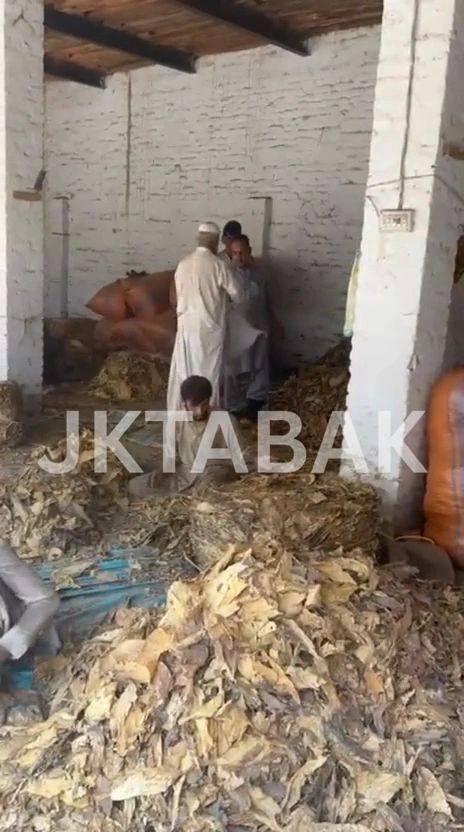
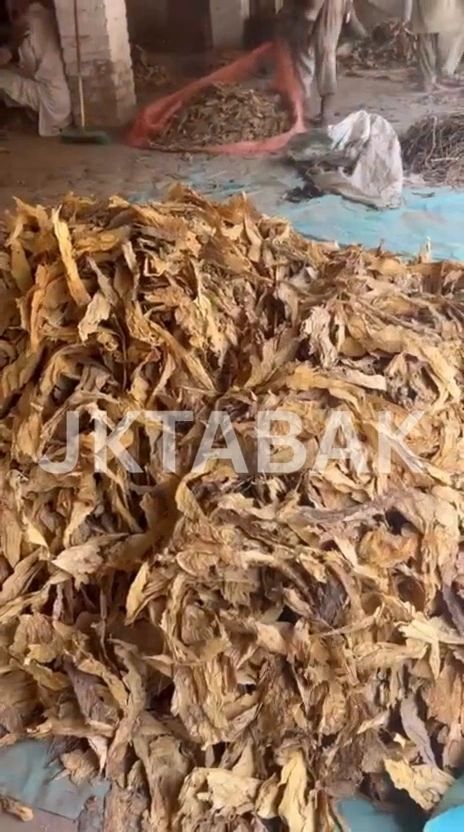
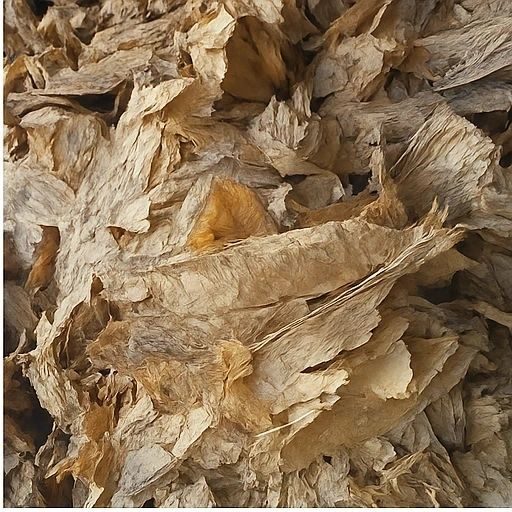
Pictures and clips of leaf we handle. For current photographs or video of a specific lot, ask us. The full sets are on the gallery and videos pages.